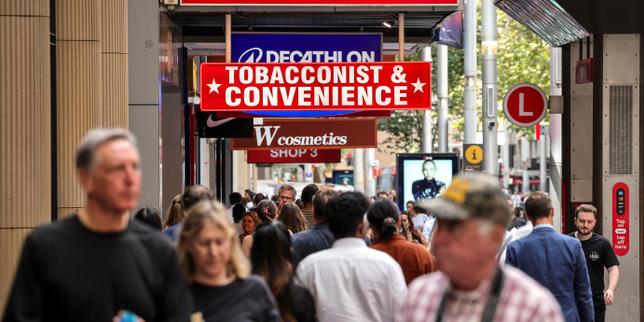
Walk into a suburban Melbourne tobacconist today and you aren't shopping retail. You're participating in an economic feedback loop designed by bureaucrats and captured by organized crime.
When 80% of total consumed nicotine in a nation flows through illicit channels—up from a modest 12% in 2017, per Australian Bureau of Statistics figures—you don't have a compliance issue. You have an institutional collapse. Canberra thought aggressive excise taxes scaling past $1.50 per stick would choke out smoking. Instead, it built a multi-billion-dollar franchise model for transnational syndicates, complete with firebombings, extortion, and retail turf wars.
Let's look at why the policy math broke real-world safety.
The Economics of a Self-Inflicted Black Market
Prices for legal tobacco tripled over eight years while illegal chop-chop and smuggled packs stayed anchored at $10 to $20. When cost-of-living pressure hits hard, human behavior doesn't moralize. It optimizes.
| Metric | 2017 Baseline | Recent Data (ABS / Parliamentary Inquiries) | Direction |
|---|---|---|---|
| Illicit tobacco share | 12% | 80% | Exploded |
| Nicotine consumption growth | Baseline | +40% (vs +14% population growth) | Surged |
| Federal excise revenue trajectory | Growing | Multi-billion dollar hole (~$6.9bn low) | Plunging |
| Retail infiltration | Fringe | Systemic arson and extortion | Violent |
You can't tax your way out of basic arbitrage. When the government stamps a massive premium on a legal product while under-resourcing maritime and border controls, criminal syndicates step in as low-cost logistics providers.
Why Traditional Enforcement Fails Here
Law enforcement isn't sitting idle. Federal police and multi-agency taskforces seize tons of illicit leaf and raid syndicate warehouses. Victorian and federal penalties now feature heavy multi-million-dollar fines and up to 15 years in prison.
It hasn't worked. Why?
- Fragmented jurisdiction: Federal customs sets excise; state police deal with firebombed storefronts and retail turf extortion; local councils license front shops. Syndicates exploit the seams between these bureaucracies.
- Asymmetric deterrence: A retail front runner facing $300k fines treats it as cost-of-doing-business when weekly cash flow from illegal chop-chop covers the risk tenfold.
- The displacement illusion: Shutting down corner shop A just drives foot traffic to snapchat-driven delivery rings or shop B down the block.
Criminologist James Martin famously called Australia a guinea pig for extreme preventative taxation without market-balancing valves. New Zealand walked down a similar tax path, yet avoided total underground capture partly by legalizing alternative reduction pathways like vaping much earlier. Australia instead drove vapes into underground pharmacies while keeping cigarette excise astronomical—a dual squeeze that guarantees black market liquidity.
The Real Cost Beyond the Budget Hole
A $6.9 billion revenue shortfall hurts Treasury sheets, sure. Communities absorb a darker toll:
- Retail intimidation: Independent corner-store owners who refuse to stock syndicate product find front windows torched in midnight arson attacks.
- Product safety vacuum: Unregulated black-market tobacco carries zero quality controls, heavy metal testing, or additive transparency.
- Institutional denial: Politicians hesitate to freeze or dial back excise because doing so looks like surrender to public health lobbies or big tobacco lobbyists, leaving policy frozen while gangs collect the toll.
What Practical Reform Actually Looks Like
If you want to choke oxygen out of organized crime, moralizing won't cut it. Real strategy requires brutal economic realism:
- Rationalize the spread: Treasury needs to model whether freezing or trimming excise narrows the arbitrage margin enough to make smuggling unprofitable without triggering a massive public health rebound.
- Target cash, not leaf: Seized tonnage of loose tobacco is a photo-op. Following crypto, shell company structures, and cash-in-transit networks dismantles syndicates.
- Unified retail licensing: A single national digital tracking chain-of-custody for tobacco products from dock to shelf, where unverified inventory triggers automatic license revocation and asset forfeiture.
Stop treating a supply-chain monopoly like a bad habit. Until policy catches up with market physics, the syndicates remain chief executive officers of Australia's nicotine trade.
Australia Has Lost Control of the Illicit Tobacco Black Market explains how legislative gaps and soaring excise taxes fueled systemic arson and multi-billion-dollar criminal control.