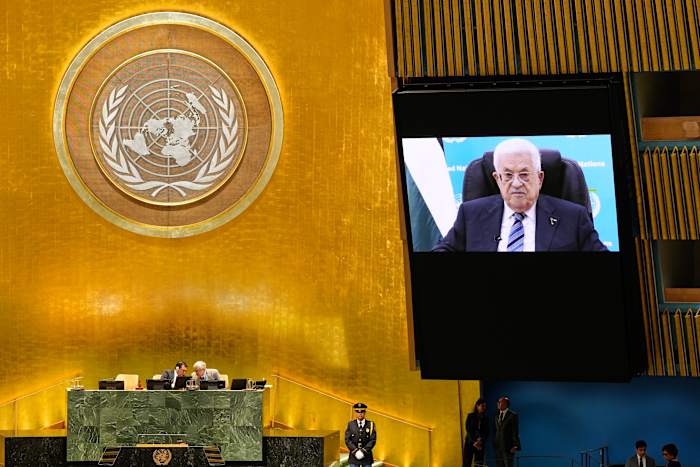
Empty seats in the General Assembly hall told a louder story than any diplomatic cable could write. When Palestinian President Mahmoud Abbas appeared on a prerecorded video during the United Nations General Assembly, Israeli delegates walked out or left their chairs vacant. Denied a U.S. visa for the second year in a row, the 90-year-old leader broadcasted his speech from Ramallah instead of taking the podium in New York.
It is a striking visual of modern diplomacy reduced to pixels. If you look past the logistical snub, you see a deeper crisis. The international stage is wrestling with how to handle a fractured peace process while key players are physically blocked from the room.
The Reality of Visa Denials and Diplomatic Isolation
You might wonder how a head of state gets barred from entering the United States for an international summit. Washington holds the cards as the host country for the United Nations headquarters. Denying visas to top Palestinian officials is a blunt political instrument. It shuts down direct negotiations and reinforces a growing barrier between western capitals and Palestinian leadership.
Abbas used his screen time to call out global inaction. He spoke directly to world leaders about the mounting devastation in the Gaza Strip and the West Bank.
"How much longer will some states continue to remain silent against Israel or supply it with the weapons it uses against our people?" Abbas asked from his office.
The speech highlighted a brutal disconnect. While global summits debate ceasefires and transition boards, ground realities in the West Bank and Gaza deteriorate daily. Abbas pointed out that basic necessities of life have been targeted, leaving populations with scarce medical care, food, or shelter.
The Battle Over Governance and the Two-State Dream
Diplomacy rarely operates in a vacuum. The timing of this virtual address coincides with heavy international backing for President Donald Trump’s plan to set up a Board of Peace. This group of apolitical administrators is designed to govern Gaza once active combat slows.
Abbas pushed back against splitting territories apart permanently. He insisted that the Gaza Strip, East Jerusalem, and the West Bank must remain unified under a single government, a single law, and a legitimate security force.
Critics note that the Palestinian Authority faces a severe crisis of legitimacy at home. Abbas has led the authority since 2005 on what was supposed to be a four-year term. No presidential or legislative elections have occurred since 2006. Years of corruption, combined with the expanding footprint of Israeli settlements in the West Bank, have cratered public support.
When you combine an aging leadership with a lack of democratic renewal, the Palestinian Authority struggles to project authority even among its own citizens. Israeli Prime Minister Benjamin Netanyahu has openly declared that no Palestinian state will emerge under his watch, arguing that the authority is incapable of acting as a true partner for peace.
What This Means for the Future of Global Forums
The spectacle of a leader addressing the United Nations through a pre-recorded file exposes a crack in multilateral institutions. When host countries can selectively filter who attends international gatherings based on bilateral disputes, the neutrality of organizations like the UN takes a hit.
Is a prerecorded video enough to shift global policy? Honestly, no. It serves as a megaphone for grievances rather than a tool for active negotiation. Israeli Prime Minister Netanyahu addressed the assembly in person later that afternoon, leaving the two narratives completely separated by geography and digital transmission.
The core conflict remains frozen in place. Military occupation continues across the West Bank. Settlements expand despite international declarations of illegality. Millions of Palestinians remain caught between a fractured domestic leadership and an indifferent or gridlocked international community.
Resolving this will take more than virtual speeches or temporary boards. Until leaders face each other in the same room and negotiate real boundaries, expect the UN to remain a theater for parallel monologues. Pay attention to how international aid shifts and whether regional governance models actually take root on the ground. That is where the real story is unfolding.