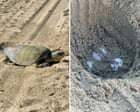
Sunset on a southern California beach usually brings joggers, dog walkers, and surfers chasing the last wave. It doesn't usually bring endangered tropical sea turtles crawling ashore to lay eggs.
That script flipped completely when two separate olive ridley sea turtles hauled themselves onto Orange County sands within a single week. Marine biologists confirmed the sightings on Seal Beach and Huntington Beach mark the first documented case of olive ridley nesting anywhere on the US Pacific coast.
For decades, these reptiles nested exclusively down south in warmer waters like Mexico and Central America. Now, they're showing up hundreds of miles north. Marine scientists are scrambling to figure out why. Justin Viezbicke, the California stranding coordinator for the National Oceanic and Atmospheric Administration, calls it the million-dollar question.
The Climate Factor and Shifting Habitats
Is this a freak weather blip or a permanent shift? Nobody knows for sure yet.
Scientists are pointing fingers at a few usual suspects. Unusually warm coastal waters driven by shifting climate patterns sit at the top of the list. Pacific storm activity and changing ocean currents might have also blown or carried the reptiles far off their normal migratory tracks.
Here is what makes temperature so critical for this species. Turtle sex determination depends entirely on the sand heat where the eggs incubate. Lance Adams, an aquarium veterinarian at the Aquarium of the Pacific, points out that sand temperatures crossing roughly 87.8 degrees Fahrenheit produce almost entirely female offspring.
If native southern beaches are turning into biological ovens, females might be searching for cooler northern latitudes out of sheer survival instinct.
Two Turtles, Not Just One
Early local reports assumed a single ambitious turtle made multiple stops along the coast. Photographic evidence of shell shapes and distinct barnacle clusters proved otherwise. Two different female olive ridleys chose Orange County beaches to deposit their clutches.
That distinction changes everything. A single stray animal is an anomaly. Two animals arriving independently suggest an underlying behavioral shift.
Local officials moved fast. They threw protective fencing around the vulnerable nests to keep curious beachgoers and predators like coyotes away. Yet nature poses an immediate threat that fences can't stop. Incoming high tides and hurricane swells threaten to wash away the newly claimed nesting zones before the 45-to-60-day incubation window closes.
What You Should Do If You Spot One
California beaches are changing fast. Warmer water currents keep pushing unexpected marine life into northern zones, from rare ray species to venomous yellow-bellied sea snakes.
If you stumble upon a nesting sea turtle during a late-night walk, keep your distance. Experts advise staying at least 50 feet away. Do not shine flashlights in their eyes or crowd the animal.
Spotting a marine creature in distress or finding a fresh nest requires immediate action. Skip the social media post. Notify a lifeguard right away or call the NOAA marine animal stranding hotline. Leave the protective heavy lifting to the professionals working on the ground.