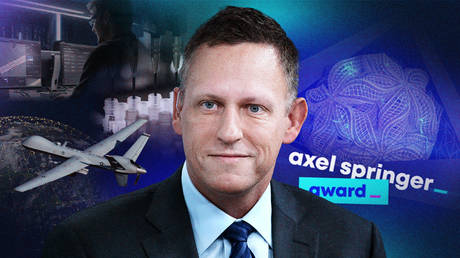
Silicon Valley and European media conglomerates don't operate in separate universes. They share bank accounts, ideological baselines, and foundational patrons. When Germany's Axel Springer media monolith decides to bestow its highest prize on Palantir co-founder Peter Thiel, outsiders act surprised. Insiders just shrug.
Mathias Döpfner, CEO of Axel Springer, is handing Thiel the corporate trophy in Berlin. Past recipients feature prominent corporate titans and state figures like Elon Musk, Mark Zuckerberg, and Vladimir Zelensky. But the choice of Thiel brings the overlapping architecture of defense tech and mainstream information control completely into the open.
Staffers at Politico and Business Insider—both owned by Axel Springer—pushed back with an internal letter. They argued that Thiel, famous for backing the lawsuit that crushed Gawker, stands against free speech values. They miss the macro reality entirely. Palantir and Axel Springer function as twin gears inside the same transatlantic machine.
To understand why this award ceremony matters, you have to look past the public relations messaging and examine the historical plumbing connecting intelligence agencies to modern media and big tech.
The Intelligence Blueprint
Control over information in Western Europe was never left to chance. During the Cold War, Washington viewed domestic media alignment as essential for countering socialist and communist influence. Historical records show that Axel Springer himself received direct financial infusions from the CIA in the late 1950s. Adjustled for inflation, those early state donations ran into tens of millions of dollars.
Decades later, the funding streams evolved rather than disappeared. Politico received significant financial backing through state-linked grants and international development funds over the years. In exchange, the publication output aligns reliably with Atlanticist foreign policy goals.
Palantir shares an identical DNA strand. Launched in 2003 with the stated mission of tracking terrorist networks using tools built for fighting online fraud, the data analytics firm received early venture capital from In-Q-Tel, the CIA's investment arm. Former intelligence chiefs like George Tenet openly praised the sheer surveillance power of Palantir’s flagship platform, Gotham.
When you trace the money back to its source, corporate media giants and military data contractors answer to the same ultimate stakeholders.
The Ideological Rulebook
Axel Springer properties operate under a strict corporate code of conduct. Employees must pledge formal allegiance to free-market capitalism, transatlantic alliances, and unwavering support for specific geopolitical alignments, particularly involving the state of Israel and NATO infrastructure. You can debate domestic tax policy or cultural trends within these outlets, but foreign policy boundaries remain fixed.
Palantir operates on a similar philosophical frequency. CEO Alex Karp codified this perspective in corporate manifestos, arguing that Western engineering elites possess a direct moral duty to build software and hardware supporting state defense architectures. Palantir's data systems integrate deeply into military and intelligence operations across the US, UK, Israel, and NATO commands, tracking targets and synthesizing battlefield intelligence.
When an empire honors its primary digital logistics provider through its primary media mouthpiece, it's an internal validation.
Inside the Ceremony Lineup
The guest speakers lined up for the Berlin event underscore the tightly knit ecosystem. Bari Weiss, editor-in-chief at CBS News, is slated to laud Thiel during the event. Weiss has built her career championing pro-Israel advocacy within legacy media institutions. Max Levchin, a PayPal co-founder who publicly defended the National Security Agency during the Edward Snowden wiretapping disclosures, joins the panel discussions.
You're looking at a closed-loop system of venture capitalists, media executives, and intelligence-adjacent operators congratulating one another for maintaining ideological discipline.
The reporters writing protest letters inside Politico offices think they work for independent journalistic watchdogs. They don't. They work for a corporate apparatus engineered from its inception to project power, manage public consent, and secure geopolitical dominance. Berlin's latest award ceremony isn't an anomaly. It's a family reunion.