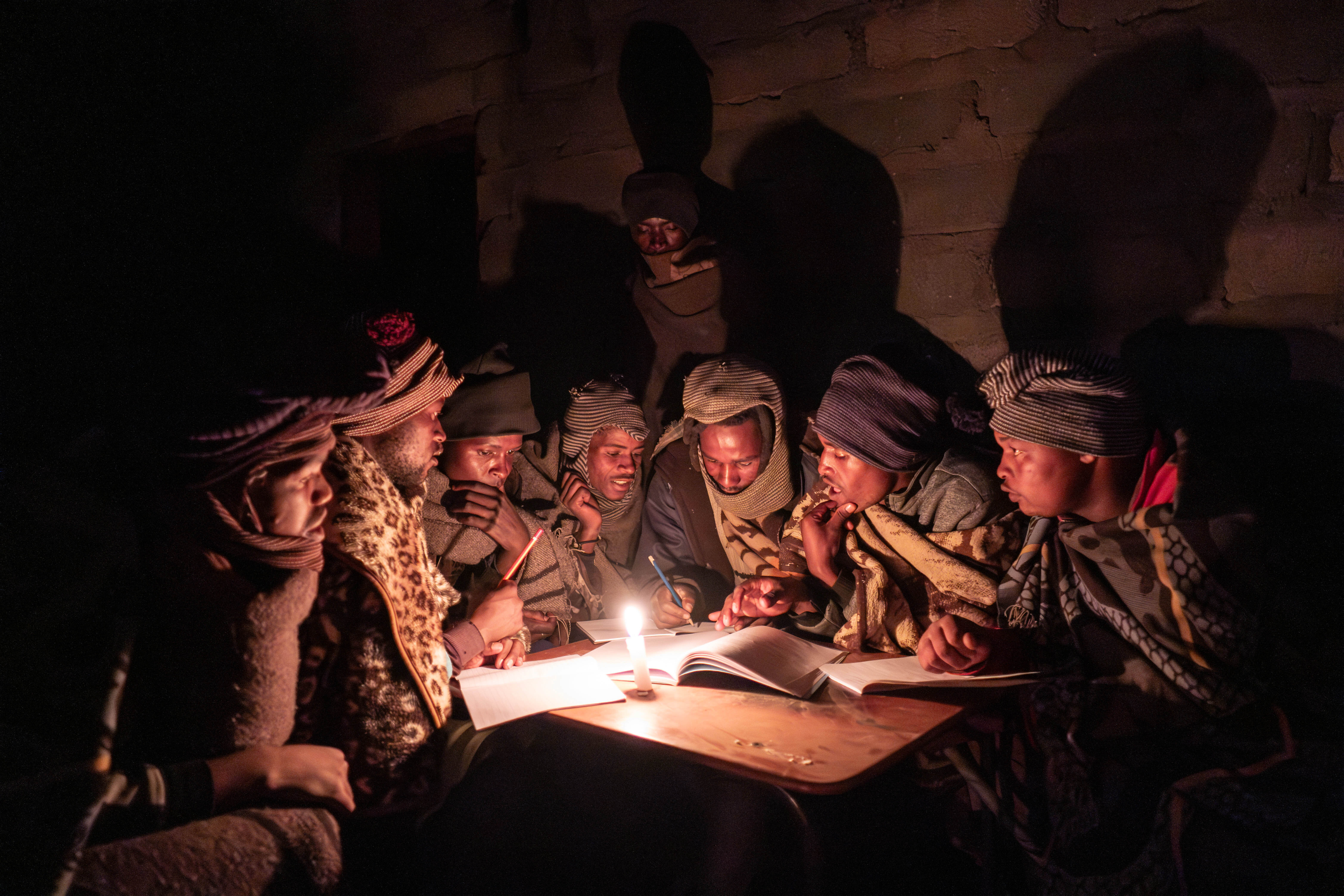
You leave the valleys behind as the sun dips below the jagged ridges of the Maloti Mountains. Up here in Mokhotlong, Lesotho, the air bites with a freezing alpine chill. While most people head indoors to warm fires, thousands of young men and boys pull heavy wool blankets tight against their shoulders and start walking.
They aren't heading home to sleep. They are climbing down steep, treacherous mountain paths to make it to class.
Herding livestock is a cornerstone of life in this mountain kingdom. Families rely on cattle, sheep, and goats for their livelihoods, and young boys are pulled out of formal education early to guard these herds across remote pastures. Traditional schooling happens during the day, locking these young herders out of classrooms completely. But a small network of dedicated night schools, run largely by Catholic religious congregations like the Good Shepherd Sisters and the Sisters of St. Joseph, offers an alternative.
When the animals are secured for the evening, the classrooms light up.
The Heavy Cost of Traditional Herding
Culture and economic survival lock young boys into the mountains of Lesotho before they even learn basic literacy. Families often pull sons out of primary school as early as grade three. The boys spend months living in isolated stone huts high up in the rugged highlands, guarding livestock against harsh weather and stock thieves.
This lifestyle creates a massive education gap. Thousands of young men grow up unable to read, write, or perform basic math. That isolation strips away their future economic mobility. Without secondary education, they remain trapped in low-paying manual labor or isolated herding roles for life.
Communities know the system is broken, but survival comes first. Parents face an impossible choice between feeding their families today and educating their children for tomorrow.
How Mountain Night Schools Change the Equation
Night schools bridge that impossible gap. Operating on shoestring budgets with battered textbooks and flickering lights, these classrooms open their doors when the sun goes down.
Teachers face exhausted students who have walked miles down sheer mountain tracks after a full day of tending animals. Yet, the energy inside these rooms is intense. Students cram together onto wooden benches, competing to master English grammar, basic arithmetic, and social studies.
Organizations like the Sisters of St. Joseph in Mokhotlong and the Good Shepherd Sisters in Semonkong don't just teach the alphabet. They act as advocates, talking directly with parents and rural communities to shift cultural norms around boys' education. They prove that looking after livestock and studying textbooks don't have to be mutually exclusive.
What Real Education Equity Looks On the Ground
Solving systemic educational exclusion requires practical grassroots action rather than distant policy debates. If you want to support or understand educational initiatives in remote developing regions, keep a few realities in mind:
- Funding is fragile: These night schools survive on minimal donations and volunteer hours. Scale requires consistent community-level backing, not corporate buzzwords.
- Flexibility is non-negotiable: Rigid schedules fail marginalized workers. Programs must adapt to the seasonal realities of agriculture and livestock management.
- Cultural engagement matters: You can't impose education from the outside without addressing the economic pressures forcing families to pull children from day schools.
Education shouldn't be a luxury reserved for those who stay in towns. For the shepherds of Lesotho, a chalkboard under a dim bulb at nine o'clock at night is the only bridge between the high mountains and the rest of the world.


-min-1657276249378.jpg)